
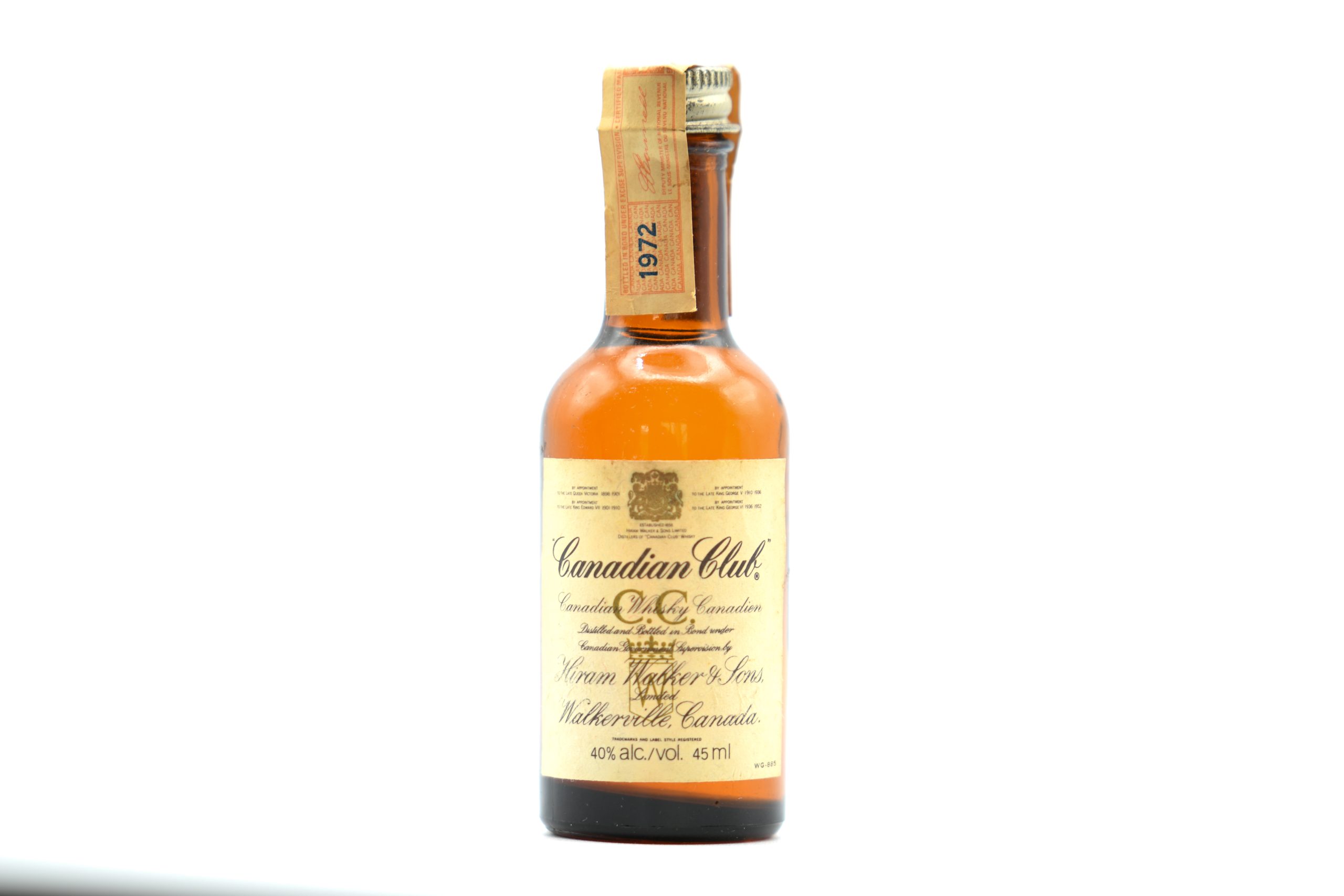

Bottle #82 is Canadian Club, one of the most famous brands of Canadian whisky. It’s also the oldest still-surviving brand, founded in 1882 by Hiram Walker. While considered one of Canada’s most influential distillers, Walker was actually a Massachusetts-born American who only spent four years actually living in Canada. But his legacy lives on!
Read the rest of the story
While the name Canadian Club was attached to Walker’s whiskey only beginning in 1882, he’d been involved in the whiskey trade for decades by that point. He’d emigrated to Detroit as a 22-year-old in 1838, and eventually married and started a grocery store. As I talked about in Bottle #30: Wild Turkey 101, it was very common for grocers to buy whiskey in bulk and bottle it for sale. This was because US laws at the time actually forbade distilleries from selling their own whiskey. Instead, they had to sell it to “rectifiers” who would filter and finish it, often by adding things like prune juice for color. Walker had been in this trade as a grocer before shifting his business to grain brokerage in 1856, when Prohibition forces in the US made the climate there even less-alcohol friendly.
But when he looked across the border to Canada, he saw a great deal of potential. Not only was there abundant land and grain supplies to support his grain business, but there he’d be able to distill, rectify, and sell his own whiskey. And so he did, distilling his first batch of whiskey just months after setting up his grain mill with attached distillery near Windsor, Ontario.
This, interestingly, is where my personal story overlaps with Hiram Walker’s, because I grew up downwind from the Hiram Walker distillery in Windsor. Which means that every time I walk into a whiskey distillery today, I’m transported back to my childhood, when the heavy smell of fermenting grain would fill the air on summer days. It’s not exactly a pleasant memory, but it does create an interesting throughline for my life! I also went to elementary school in the heart of Walkerville, the thriving company town that grew up around the distillery and is now a neighborhood of Windsor.
Walker’s whiskey had a base made mostly from corn, blended with a high-rye flavoring whiskey, and colored with a bit of burnt sugar. It quickly became popular both in the US and Canada, and in 1867 Walker even started exporting outside of North America. But it wasn’t Canadian Club yet.
In 1878 increasing tariffs between the US and Canada meant that Walker could no longer compete based on price, so he decided to pivot to quality. He studied the US market and came up with another blend of corn and rye whiskies, but this time aged instead of just colored. He christened it “Club” and began marketing it heavily. In 1883 Canada adopted a bottled-in-bond practice. While this was created to let distillers wait to pay taxes until they bottled an aged whisky, the side effect of it was that it was a reliable marker of quality: it certified that the whisky had indeed been aged. The US wouldn’t adopt a similar standard until 1897, so that meant that for a time, Canadian whisky had an aura of quality around it.
Like pretty much all famous brands there’s a mythology about Canadian Club. The claim about how the word “Canadian” got into the name is that the “Club” whiskey got so popular that its sales impacted sales of bourbon in the US, inspiring a petition which forced the US Government to require Canadian distillers to label their bottles. Even the Canadian Club website is spreading this bit of mythology, but according to Davin de Kergommeaux, THE expert on Canadian whisky, it’s just not true. There’s no evidence there was ever a petition and it wasn’t until the 1950s that distillers were required to include the word Canadian on their labels. Club Whisky’s sales did increase when it became Canadian Club in 1888, perhaps because of that aura of quality from the bottled-in-bond act. But it was an increase from 600 cases to 3000 cases – hardly a threat to US bourbon manufacturers. But it did end up becoming world famous and available in 155 different countries, most of which still sell it today.
I’m pretty sure my tiny bottle of Canadian Club is from Canada, based on a whisper of French on the label, and the lack of an “Imported” statement that I see on other bottles from this time period. Time period was easy to determine, because this bottle does have a Bottled-in-Bond strip on it, which lists the year the youngest whiskey in the blend was distilled: 1972. It doesn’t have an age statement on it, but the exported 1972 bottles online state that the whisky is 6 years old. And that matches up to my bottle, which has a 78 embossed on the bottom, which indicates the year the bottle itself was made.
Today’s Canadian Club doesn’t have the best reputation. There are a lot of newer, hipper distilleries making better crafted Canadian whiskies. Reviews of 70s era vintage bottles definitely rank it higher than the modern bottling, even though the 70s was a time period when the industry was shifting to making lighter whiskies. So I am looking forward to trying it, and I have the perfect tasting buddy picked out to do it with – my dad. You see, 1972 also happens to be my birth year, so it feels only right that I should taste it with him. I’m sure my first taste of Canadian whisky – or rye, as we all call it there – was from his glass, mixed with ginger ale, so it’s time for me to return the favor!
Watch me taste this bottle with my Dad! And then taste it a second time with my friend Jered.
Want even more My Tiny Bottles? Patreon supporters get access to bonus content, behind the scenes information, monthly cocktail recipes and more. Become a free member or paid supporter here!
Watch Now
Listen Now
Bottle #82 is Canadian Club, one of the most famous brands of Canadian whisky. It’s also the oldest still-surviving brand, founded in 1882 by Hiram Walker. While considered one of Canada’s most influential distillers, Walker was actually a Massachusetts-born American who only spent four years actually living in Canada. But his legacy lives on!
While the name Canadian Club was attached to Walker’s whiskey only beginning in 1882, he’d been involved in the whiskey trade for decades by that point. He’d emigrated to Detroit as a 22-year-old in 1838, and eventually married and started a grocery store. As I talked about in Bottle #30: Wild Turkey 101, it was very common for grocers to buy whiskey in bulk and bottle it for sale. This was because US laws at the time actually forbade distilleries from selling their own whiskey. Instead, they had to sell it to “rectifiers” who would filter and finish it, often by adding things like prune juice for color. Walker had been in this trade as a grocer before shifting his business to grain brokerage in 1856, when Prohibition forces in the US made the climate there even less-alcohol friendly.
But when he looked across the border to Canada, he saw a great deal of potential. Not only was there abundant land and grain supplies to support his grain business, but there he’d be able to distill, rectify, and sell his own whiskey. And so he did, distilling his first batch of whiskey just months after setting up his grain mill with attached distillery near Windsor, Ontario.

This, interestingly, is where my personal story overlaps with Hiram Walker’s, because I grew up downwind from the Hiram Walker distillery in Windsor. Which means that every time I walk into a whiskey distillery today, I’m transported back to my childhood, when the heavy smell of fermenting grain would fill the air on summer days. It’s not exactly a pleasant memory, but it does create an interesting throughline for my life! I also went to elementary school in the heart of Walkerville, the thriving company town that grew up around the distillery and is now a neighborhood of Windsor.


Walker’s whiskey had a base made mostly from corn, blended with a high-rye flavoring whiskey, and colored with a bit of burnt sugar. It quickly became popular both in the US and Canada, and in 1867 Walker even started exporting outside of North America. But it wasn’t Canadian Club yet.
In 1878 increasing tariffs between the US and Canada meant that Walker could no longer compete based on price, so he decided to pivot to quality. He studied the US market and came up with another blend of corn and rye whiskies, but this time aged instead of just colored. He christened it “Club” and began marketing it heavily. In 1883 Canada adopted a bottled-in-bond practice. While this was created to let distillers wait to pay taxes until they bottled an aged whisky, the side effect of it was that it was a reliable marker of quality: it certified that the whisky had indeed been aged. The US wouldn’t adopt a similar standard until 1897, so that meant that for a time, Canadian whisky had an aura of quality around it.
Like pretty much all famous brands there’s a mythology about Canadian Club. The claim about how the word “Canadian” got into the name is that the “Club” whiskey got so popular that its sales impacted sales of bourbon in the US, inspiring a petition which forced the US Government to require Canadian distillers to label their bottles. Even the Canadian Club website is spreading this bit of mythology, but according to Davin de Kergommeaux, THE expert on Canadian whisky, it’s just not true. There’s no evidence there was ever a petition and it wasn’t until the 1950s that distillers were required to include the word Canadian on their labels. Club Whisky’s sales did increase when it became Canadian Club in 1888, perhaps because of that aura of quality from the bottled-in-bond act. But it was an increase from 600 cases to 3000 cases – hardly a threat to US bourbon manufacturers. But it did end up becoming world famous and available in 155 different countries, most of which still sell it today.
I’m pretty sure my tiny bottle of Canadian Club is from Canada, based on a whisper of French on the label, and the lack of an “Imported” statement that I see on other bottles from this time period. Time period was easy to determine, because this bottle does have a Bottled-in-Bond strip on it, which lists the year the youngest whiskey in the blend was distilled: 1972. It doesn’t have an age statement on it, but the exported 1972 bottles online state that the whisky is 6 years old. And that matches up to my bottle, which has a 78 embossed on the bottom, which indicates the year the bottle itself was made.
Today’s Canadian Club doesn’t have the best reputation. There are a lot of newer, hipper distilleries making better crafted Canadian whiskies. Reviews of 70s era vintage bottles definitely rank it higher than the modern bottling, even though the 70s was a time period when the industry was shifting to making lighter whiskies. So I am looking forward to trying it, and I have the perfect tasting buddy picked out to do it with – my dad. You see, 1972 also happens to be my birth year, so it feels only right that I should taste it with him. I’m sure my first taste of Canadian whisky – or rye, as we all call it there – was from his glass, mixed with ginger ale, so it’s time for me to return the favor!
Watch me taste this bottle with my Dad! And then taste it a second time with my friend Jered.
Want even more My Tiny Bottles? Patreon supporters get access to bonus content, behind the scenes information, monthly cocktail recipes and more. Become a free member or paid supporter here!
0 Comments